

Sound and Music Computing
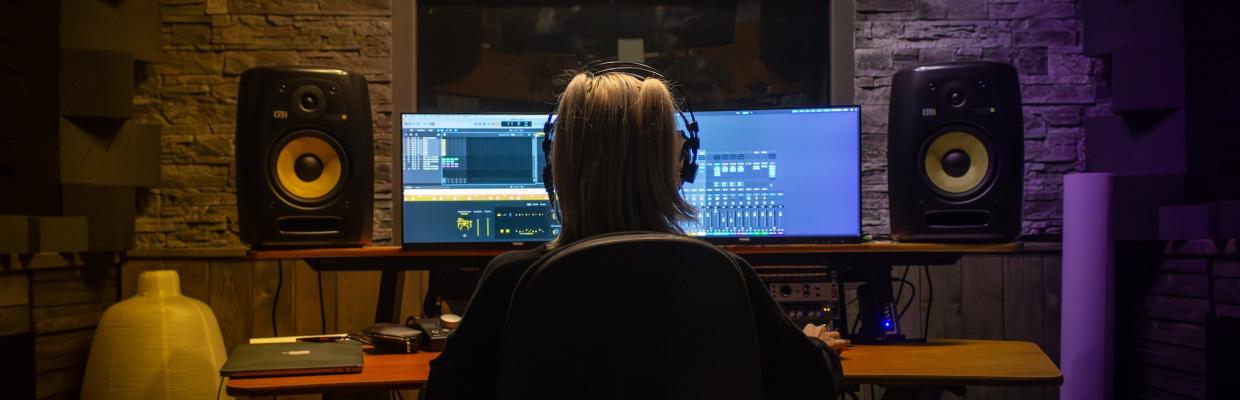
To this end, the study programme is strongly multidisciplinary:
Basic course units are designed to provide knowledge and skills in the fundamental areas of computer science, including the scientific inquiry method, the development of computer systems, and the mathematical foundations supporting computer science.
Core course units deepen knowledge and skills in areas of computer science that are particularly relevant to music informatics and its main application domains (such as digital musical instruments, music production, music publishing, sound design, new media, and musical cultural heritage).
Related and supplementary course units offer knowledge and competences in other disciplinary fields (including acoustics, psychoacoustics, elements of music theory and harmony, economics and law of musical heritage, and music publishing), with the goal of enriching students? ability to address and analyse issues related to applications of music informatics from multiple perspectives.
To achieve all the educational objectives outlined above, the programme includes lectures, practical exercises, and laboratory activities.
Role in a Work Context
The professional profile that the Bachelor?s Degree Programme in Music Informatics aims to train, with a view to immediate entry into the workforce, is that of a graduate capable of collaborating in technical-operational and professional roles involving consultancy, analysis, design, management, maintenance, and marketing of computer systems?both small-scale and large-scale systems?and, in particular, systems for the representation, analysis, and processing of audio and musical information.
Competences Associated with the Role
The Bachelor?s Degree Programme in Music Informatics provides knowledge of the methods and techniques needed for the development of computer and telematic systems and applications, along with the cultural foundations required to adapt to the continuous evolution of the discipline.
The competences acquired include foundational areas of computer science, as well as subjects related to music informatics (audio signal processing, models of audio and musical information for analysis and synthesis, audio programming) and other relevant disciplinary fields (acoustics of musical instruments and listening spaces, psychoacoustics, elements of music theory and harmony, economics and law of musical heritage, music publishing).
These competences also include familiarity with the scientific method of inquiry and the ability to understand and use the mathematical tools that support computer science skills.
Graduates in Music Informatics will also be able to use the English language within their specific field of expertise and for general information exchange. Finally, they will be able to work autonomously as well as supervise and collaborate in team environments, integrating effectively into any workplace.
Career Opportunities
Graduates in Music Informatics can work in all occupational and professional sectors relevant to graduates of this degree class, namely the design, organisation, management, and maintenance of computer systems, whether in companies operating in the areas of computer systems and networks, in businesses, in public administration, or more generally, in any organisation that employs computer systems.
In addition, graduates will be able to work in professional and occupational sectors specific to Music Informatics, such as digital musical instruments, technologies for music production and publishing, sound design, new media, and technologies for cultural heritage.
Employment statistics (Almalaurea)
Erasmus: the coordinator for the Department of Informatics is Prof. Fabio Scotti.
International Programs: the coordinator for the Department of Informatics is Prof. Davide Rocchesso.
More information are available at the following link: https://di.unimi.it/it/rapporti-internazionali/mobilita-internazionale/opportunita-internazionali
To be admitted to the Degree Course, candidates must have a secondary school diploma or another qualification obtained abroad, recognized as suitable, as well as having adequate initial preparation. In particular, knowledge of basic scientific disciplines and understanding of elementary logic with a level of depth equal to that deriving from secondary school preparation are required.
Methods of verification of knowledge and personal preparation
The methods of access are established by the Admission Notice published on the page: https://informatica.cdl.unimi.it/it/iscriversi.
The course has a limited number of places in order to guarantee the quality of the educational offer in relation to the available resources and requires a TOLC (CISIA Online Test) as a test for admission. For enrollment in the first year, 150 places are available, of which 5 are reserved for non-EU students not residing in Italy. The TOLC can be taken at the University of Milan or any other university belonging to CISIA (Interuniversity Consortium for Integrated Access Systems). Registration for the TOLC must be done on the CISIA website (https://www.cisiaonline.it/).
The TOLC valid for registration is the TOLC-S, composed of the following sections: Basic mathematics (20 questions - 50 minutes), Reasoning, problems and text comprehension (15 questions - 30 minutes). Score: +1 for each correct answer, -0.25 for each incorrect answer, 0 for each unanswered question. The TOLC contains some additional sections (Biology, Chemistry, Physics, Geology, English). The results of these sections do not contribute to the test score.
After taking the TOLC-S, students must register for the selection for admission to the Degree Course, as indicated in the announcement. They will then be included in the merit ranking that will be formulated on the basis of the score obtained in the test, weighted, for each section, according to the criteria indicated in the announcement. The winners will be able to enroll within the established deadlines.
The selection is divided into distinct periods starting in February and ending in the first days of September.
Enrolled students who have not achieved a score greater than or equal to 10 in the Basic Mathematics module of the TOLC will be assigned Additional Training Obligations (OFA).
Additional training obligations and OFA recovery methods
For students with OFA, support activities will be organized in the period October-December, followed by a recovery test with which the student will have to demonstrate that he/she has improved his/her preparation. In the absence of this evidence, the student will not be able to take any second-year exams before passing the Mathematics I exam. Information: https://informaticamusicale.cdl.unimi.it/it/studiare/le-matricole
Transfers and second degrees
Students already enrolled in a degree course at the University of Milan, at another University or already graduated, can be exempted from the test only if they meet the following requirements to be verified during the pre-evaluation of their career:
- if the student, during the pre-evaluation phase, is recognized at least 30 credits, he/she is admitted to the second year or third year with exemption from the test;
- if the student is recognized less than 30 credits, he/she must register for the test and selection as indicated above.
To access the pre-evaluation, a specific request for preventive evaluation of the career must be submitted by accessing the online service indicated in the admission notice. Those interested must declare all the exams taken with the relative sectors, credits and grades and attach the course programs. For further details on the procedure, please refer to the announcement. The request for career evaluation must be submitted without fail by the date indicated in the announcement. The outcome of the evaluation will be communicated via email by the date indicated in the announcement.
Students admitted to years subsequent to the first must enroll by the deadlines and in the manner specified in the announcement.
Part-time enrollment
Part-time enrollment is also possible. The relevant Regulations can be found at the following link https://www.unimi.it/it/ateneo/normative/regolamenti/regolamento-le-iscrizioni-tempo-parziale
Places available: 150 + 5 reserved for non-EU citizens + 1 reserved for students in the Marco Polo project
Call for applications
Please refer to the call for admission test dates and contents, and how to register.
Session: 1
Application for admission: from 12/03/2026 to 11/06/2026
Application for enrolment: from 18/06/2026 to 30/06/2026
Session: 2
Application for admission: from 02/07/2026 to 10/09/2026
Application for enrolment: from 16/09/2026 to 23/09/2026
| Courses or activities | Max ECTS | Total hours | Language | SSD |
|---|---|---|---|---|
| Compulsory | ||||
| Computer Programming I | 12 | 120 | Italian | INFO-01/A |
| Mathematics I | 9 | 84 | Italian | MATH-02/B MATH-03/A |
| Music Semiotics | 6 | 48 | Italian | PHIL-04/B |
| Courses or activities | Max ECTS | Total hours | Language | SSD |
|---|---|---|---|---|
| Compulsory | ||||
| Acoustics and Psychoacoustics | 12 | 96 | Italian | PHYS-01/A PSIC-01/A |
| Computer Architecture | 6 | 48 | Italian | INFO-01/A |
| Elements of Musical Goods Economics | 6 | 48 | Italian | ECON-06/A |
| Mathematics Ii | 6 | 56 | Italian | MATH-02/B MATH-03/A |
| Courses or activities | Max ECTS | Total hours | Language | SSD |
|---|---|---|---|---|
| Compulsory | ||||
| English Assessment B1 (3 ECTS) | 3 | 0 | English | NN |
| Courses or activities | Max ECTS | Total hours | Language | SSD |
|---|---|---|---|---|
| Compulsory | ||||
| Algorithms and Data Structures | 6 | 48 | Italian | INFO-01/A |
| Audio and Signal Processing | 12 | 108 | Italian | INFO-01/A |
| Computer Networks | 6 | 48 | Italian | INFO-01/A |
| Operating Systems | 6 | 48 | Italian | INFO-01/A |
| Courses or activities | Max ECTS | Total hours | Language | SSD |
|---|---|---|---|---|
| Compulsory | ||||
| Artificial Intelligence for Music | 6 | 48 | Italian | INFO-01/A |
| Computer Programming Ii | 6 | 48 | Italian | INFO-01/A |
| Fundamentals of Sound and Digital Music | 12 | 96 | Italian | INFO-01/A |
| Statistics and Data Analysis | 6 | 60 | Italian | INFO-01/A |
| Courses or activities | Max ECTS | Total hours | Language | SSD |
|---|---|---|---|---|
| Compulsory | ||||
| Databases and Web | 12 | 120 | Italian | INFO-01/A |
| Elements of Musical Information Law | 6 | 48 | Italian | GIUR-01/A |
| Methods and Technologies of Music Publishing | 6 | 48 | Italian | GSPS-06/A |
| Courses or activities | Max ECTS | Total hours | Language | SSD |
|---|---|---|---|---|
| Compulsory | ||||
| Training | 15 | 0 | Italian | NN |
| Final Exam | 3 | 0 | Italian | NN |
| Courses or activities | Max ECTS | Total hours | Language | SSD |
|---|---|---|---|---|
| Optional | ||||
| Development of Music Production Technologies | 6 | 48 | Italian | INFO-01/A |
| Human-Computer Interaction | 6 | 48 | Italian | INFO-01/A |
| Multimedia Publishing | 6 | 48 | Italian | INFO-01/A |
The student must earn 6 ECTS credits by choosing from Table 1 below starting from the second year.
| Courses or activities | Max ECTS | Total hours | Language | Lesson period | SSD |
|---|---|---|---|---|---|
| Development of Music Production Technologies | 6 | 48 | Italian | Second semester | INFO-01/A |
| Human-Computer Interaction | 6 | 48 | Italian | Second semester | INFO-01/A |
| Multimedia Publishing | 6 | 48 | Italian | Second semester | INFO-01/A |
The student must earn 12 ECTS credits freely chosen from the courses listed below, provided that their contents do not overlap with those of courses offered by the degree programs in Computer Science or by other degree programs overseen by the Department of Computer Science, and as long as they are consistent with the study plan:
the guided elective courses;
the courses activated by the University;
specific courses offered by the Teaching Committee (see below);
specific complementary learning activities (see below);
specific courses activated by the Milan Conservatory (see below).
Courses belonging to degree programs from a previous academic system (old-system degree programs) may not be selected.
Complementary Learning Activities
Particularly noteworthy is the Steinberg Cubase certification (3 ECTS), which can be obtained by attending the seminar series "Steinberg Cubase Audio Production Framework" organized by the Department of Computer Science.
Students may also request recognition of ECTS credits for learning activities carried out at external institutions by submitting the relevant certification.
Each certification may grant up to 3 ECTS, and up to two certifications may be recognized.
Students wishing to request credit recognition must fill out the "application" form available at:
https://www.unimi.it/it/studiare/servizi-gli-studenti/segreterie-infostudenti/modulistica-generale
and submit it to the student office of their degree program together with copies of the obtained certifications.
The evaluation will be carried out by a dedicated committee based on the following criteria:
Validity: the certification must have been obtained within the last 5 years.
Specificity: the certification must concern skills relevant to those required by the degree program in which the student is enrolled.
Specialization: the certification must relate to specialized and/or professional skills.
Level: the certification must attest to intermediate or advanced skills. Basic or entry-level certifications are excluded.
Specific courses offered by the Milan Conservatory
Please note that, within a collaboration agreement for scientific and educational activities between the University of Milan and the "Giuseppe Verdi" Conservatory of Milan, an arrangement is in place that allows students to include, among their free‑choice activities, certain courses offered by the Conservatory.
The list of these courses is provided in the Specific Agreement document, which can be accessed from the Music Informatics Degree Programme website at the following link:
https://informaticamusicale.cdl.unimi.it/it/il-corso/piano-formativo-su-misura
Economic, Ethical, Social, and Legal Aspects of the IT Profession, 3 ECTS, 1st semester
Digital Publishing, 6 ECTS, 2nd semester
Image Processing, 6 ECTS, 1st semester
Multimedia Information, 12 ECTS, 1st semester
Human-Computer Interaction, 6 ECTS, 1st semester
Software Engineering, 12 ECTS, 1st semester
Mobile Computing, 9 ECTS, 1st semester
Principles and Models of Perception, 6 ECTS, 1st semester
Data Visualization, 6 ECTS, 1st semester
Computer Graphics, 6 ECTS, 2nd semester
Digital Marketing, 6 ECTS, 1st semester
Development of Technologies for Music Production, 6 ECTS, 2nd semester
| Learning activity | Prescribed foundation courses |
|---|---|
| Algorithms and Data Structures | Computer Programming I (compulsory) |
| Audio and Signal Processing | Mathematics I (compulsory) |
| Computer Programming Ii | Computer Programming I (compulsory) |
| Statistics and Data Analysis | Mathematics I (compulsory) |
Guidance:
Admission, ranking and enrolment
Other course venues: Teaching sector, via Celoria 20; Teaching sector, via Golgi 19; Teaching sector, via
Venezian 15.
- Commissione Orientamento in Uscita
Via Celoria 18 - 20133 Milano
https://di.unimi.it/it/dipartimento/organizzazione/commissioni
[email protected] - Commissione Orientamento in Ingresso
Via Celoria 18 - 20133 Milano
https://di.unimi.it/it/dipartimento/organizzazione/commissioni
[email protected] - Commissione Studenti Erasmus ed Internazionali
Via Celoria 18 - 20133 Milano
https://di.unimi.it/it/dipartimento/organizzazione/commissioni
[email protected] - Commissione Piani di Studio
Via Celoria 18 - 20133 Milano
https://di.unimi.it/it/dipartimento/organizzazione/commissioni
[email protected] - Commissione Trasferimenti
Via Celoria 18 - 20133 Milano
https://di.unimi.it/it/dipartimento/organizzazione/commissioni
[email protected] - Commissione Tirocini e Tesi Laurea Triennale
Via Celoria 18 - 20133 Milano
https://di.unimi.it/it/dipartimento/organizzazione/commissioni
[email protected] - Segreterie Studenti
Via Celoria 18 - 20133 Milano
https://www.unimi.it/it/node/359/
+390250325032
https://www.unimi.it/it/node/360 - Rappresentanti Studenti
[email protected] - Ufficio per la didattica
Via Celoria 18 - 20133 Milano
https://di.unimi.it/it/dipartimento/segreterie-e-servizi/ufficio-la-didattica
https://informastudenti.unimi.it/saw/ess?AUTH=SAML
+390250316250/252
Sportello su appuntamento ([email protected])
For students enrolled in Bachelor's, Master's and single-cycle degree programmes, tuition fees are to be paid in two instalments:
- the amount of the first instalment is the same for all students and is due upon enrolment
- the amount of the second instalment varies according to each student's ISEE University value and the degree programme in which they are enrolled
- for international students with income and assets abroad, the second instalment varies according to their country of origin.
Education incentive programmes and other benefits
The University offers scholarships, cafeterias, subsidised accommodation and other forms of financial support to students meeting specific economic and merit requirements.
More information